These flyers may be printed and shared freely, unaltered and with attribution. Not for resale or modification.
© 2026 Rebecca Koré · Brújula Press
Neurodynamic Psychology
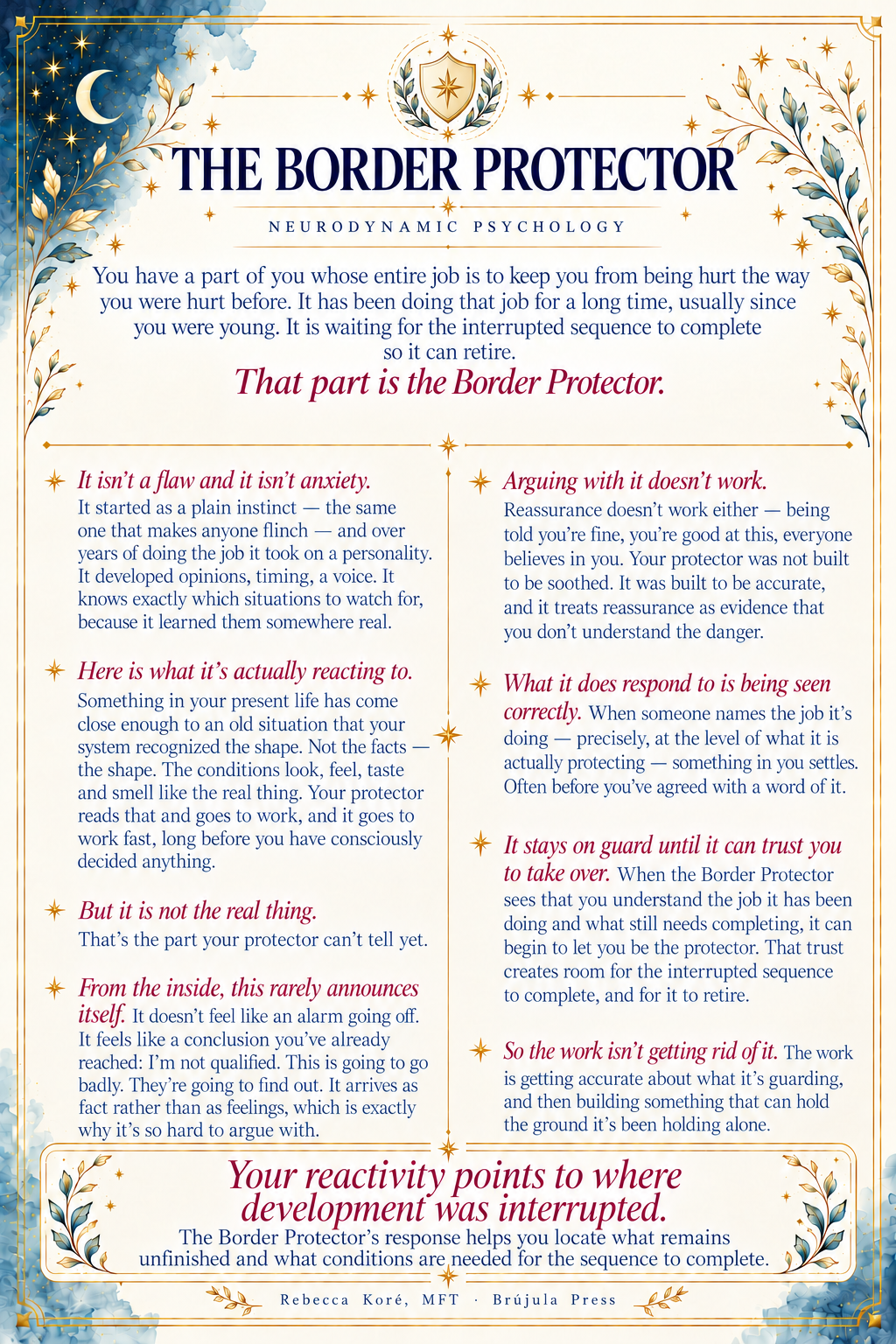
The Border Protector
You have a part of you whose entire job is to keep you from being hurt the way you were hurt before. It has been doing that job for a long time, usually since you were young. It is waiting for the interrupted sequence to complete so it can retire.
That part is the Border Protector.
It isn’t a flaw and it isn’t anxiety.
It started as a plain instinct — the same one that makes anyone flinch — and over years of doing the job it took on a personality. It developed opinions, timing, a voice. It knows exactly which situations to watch for, because it learned them somewhere real.
Here is what it’s actually reacting to.
Something in your present life has come close enough to an old situation that your system recognized the shape. Not the facts — the shape. The conditions look, feel, taste and smell like the real thing. Your protector reads that and goes to work, and it goes to work fast, long before you have consciously decided anything.
But it is not the real thing.
That’s the part your protector can’t tell yet.
From the inside, this rarely announces itself.
It doesn’t feel like an alarm going off. It feels like a conclusion you’ve already reached: I’m not qualified. This is going to go badly. They’re going to find out. It arrives as fact rather than as feeling, which is exactly why it’s so hard to argue with.
Arguing with it doesn’t work.
Reassurance doesn’t work either — being told you’re fine, you’re good at this, everyone believes in you. Your protector was not built to be soothed. It was built to be accurate, and it treats reassurance as evidence that you don’t understand the danger.
What it does respond to is being seen correctly.
When someone names the job it’s doing — precisely, at the level of what it is actually protecting — something in you settles. Often before you’ve agreed with a word of it.
It stays on guard until it can trust you to take over.
When the Border Protector sees that you understand the job it has been doing and what still needs completing, it can begin to let you be the protector. That trust creates room for the interrupted sequence to complete, and for it to retire.
So the work isn’t getting rid of it.
The work is getting accurate about what it’s guarding, and then building something that can hold the ground it’s been holding alone.
Your reactivity points to where development was interrupted.
The Border Protector’s response helps you locate what remains unfinished and what conditions are needed for the sequence to complete.